Advice · Field service
What tools belong in a service case?
A service case has to cover the unexpected without weighing a ton. Here is how to put one together: the essential core, the additions your trade calls for, and how to keep it usable job after job.
Set the scope first
A case that tries to do everything is no use: too heavy, it stays in the garage. List the jobs you really do: restarting on a car park, adjusting on site, repairing a support vehicle, replacing a simple part. What comes out once a year does not belong in the case.
The essential core
Tightening and loosening
A socket set with a ratchet is the foundation. Plan for several drives (¼″ for small fasteners, ⅜″ as the all-rounder, ½″ for larger fastenings), extension bars and a universal joint. Add combination or ratcheting spanners for places a socket cannot reach.
Screwdriving
Flat and Phillips screwdrivers in several sizes, Torx and hex bits, and a ratchet handle for the bits. Think about the screw profiles on your machines before buying: they make the decision.
Gripping and cutting
Slip-joint pliers, long-nose pliers, diagonal cutters, circlip pliers if you strip down shafts. A compact hacksaw helps far more often than you would expect.
Striking and measuring
A mallet, pin punches, a tape measure and a rule. Calipers take little room and prevent many ordering errors.
Consumables
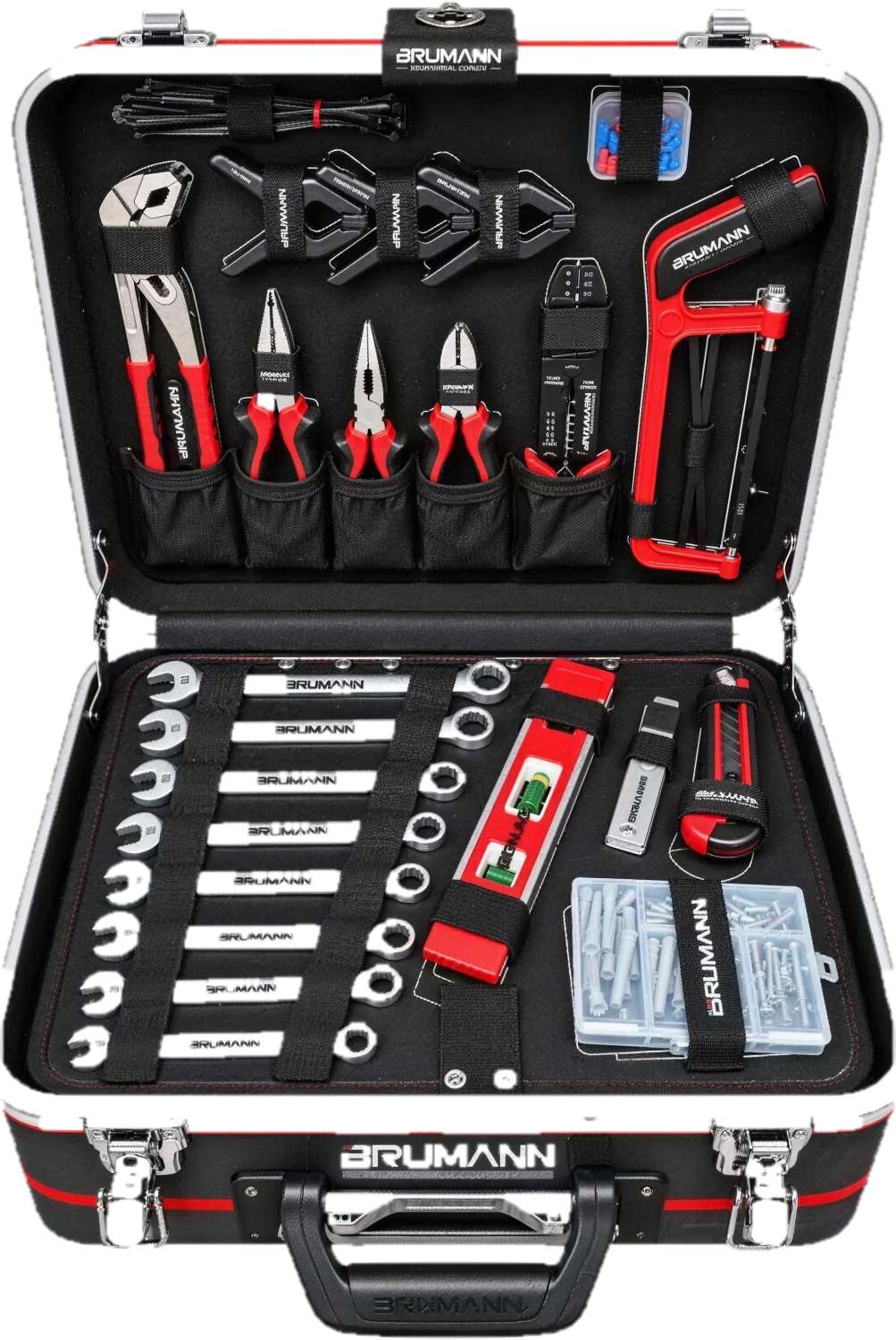
Cable ties, screws, wall plugs, nails, spare saw blades: they are tiny, but they are what you run out of. The Brumann service case carries several of them: wall plugs, nails, saw blades and hose clamps are included.
Beyond the tools
A head torch, gloves, rags, a marker. A forgotten torch costs more than a missing spanner.
What about torque?
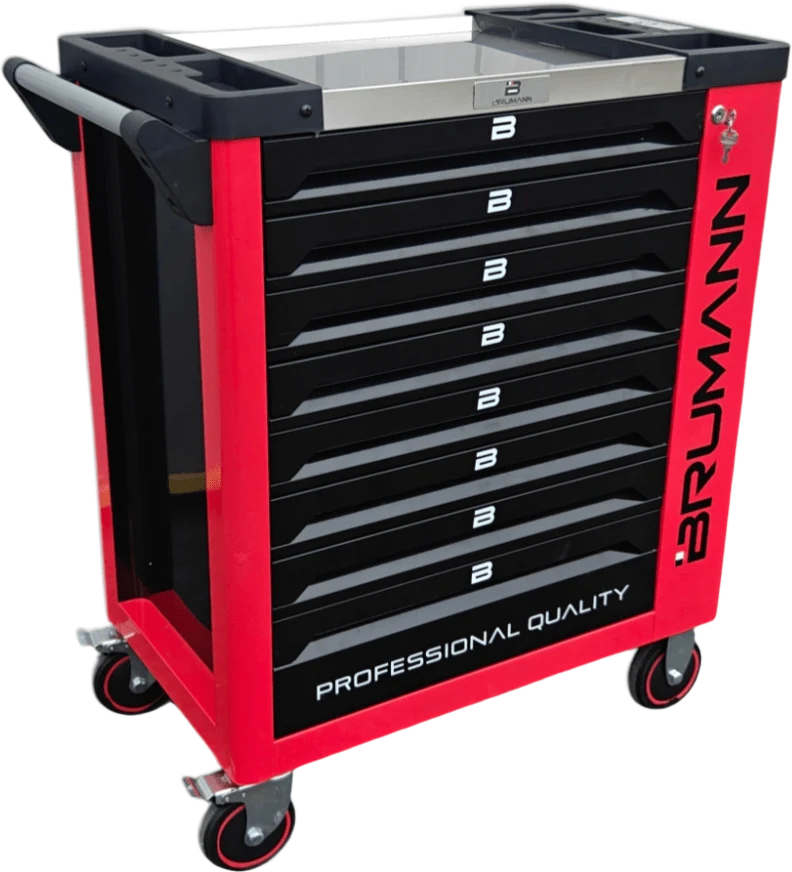
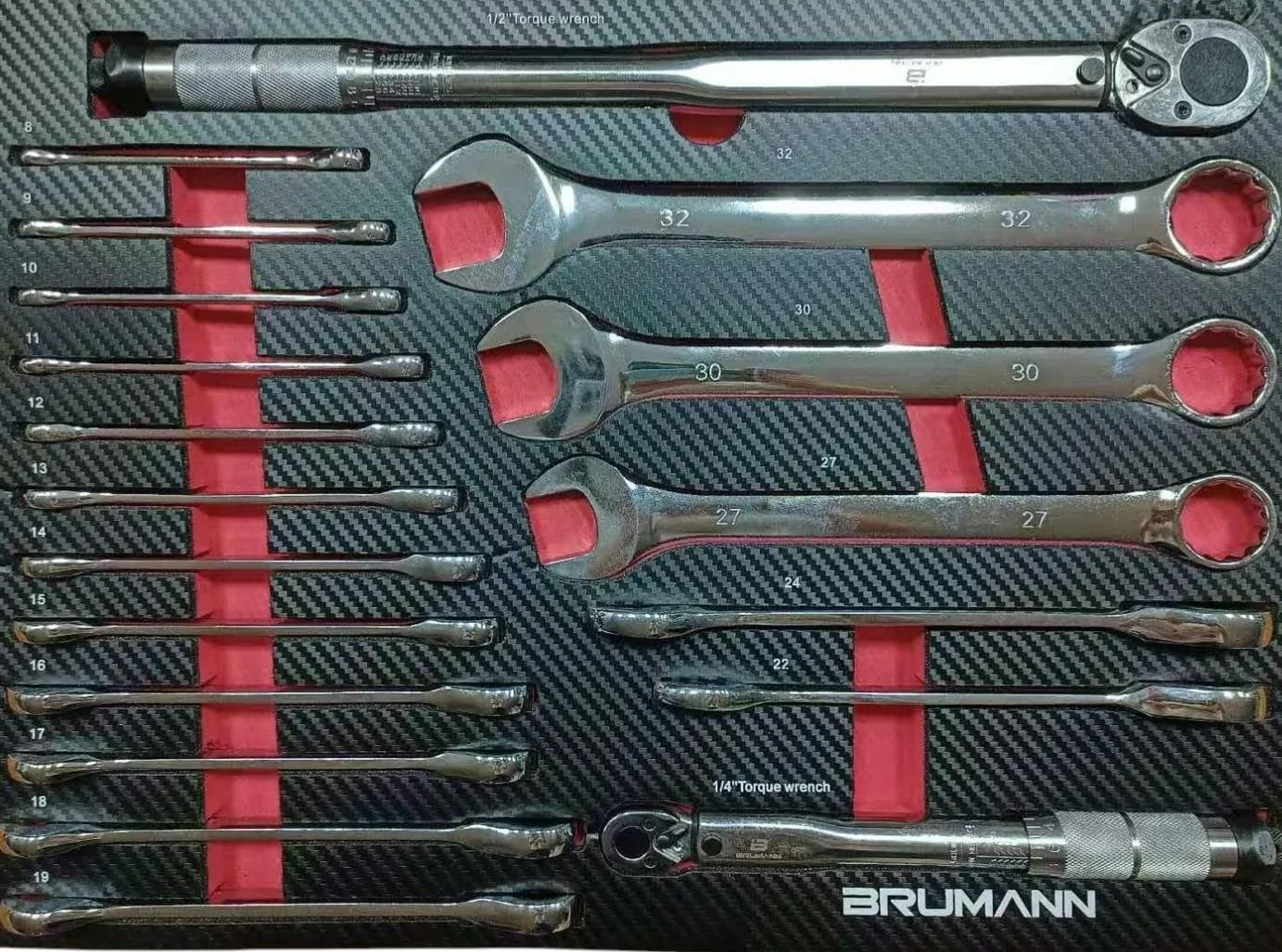
If your job calls for a specific torque, a torque wrench belongs in the kit, or the case is not enough. Check the exact contents on each product’s page before you decide. The Max Edition carries two torque wrenches, 5 to 25 N·m and 40 to 210 N·m, but it is a workshop trolley, not travelling equipment.
Organise to find things fast
- Store by family: tightening, screwdriving, pliers, measuring, consumables.
- Give every tool a fixed place, wedged so it cannot rattle around.
- Keep consumables in separate, labelled boxes.
- After each job, put everything back and restock what was used.
- Photograph the case when it is properly packed: it becomes the reference for checking nothing is missing.
Keep this list alive. After a few months you will know which tools never come out and which are missing every time: remove the first, add the second. A good case is never fixed; it reflects your real jobs, not the ones you imagined at the time of purchase.
Weight and mobility
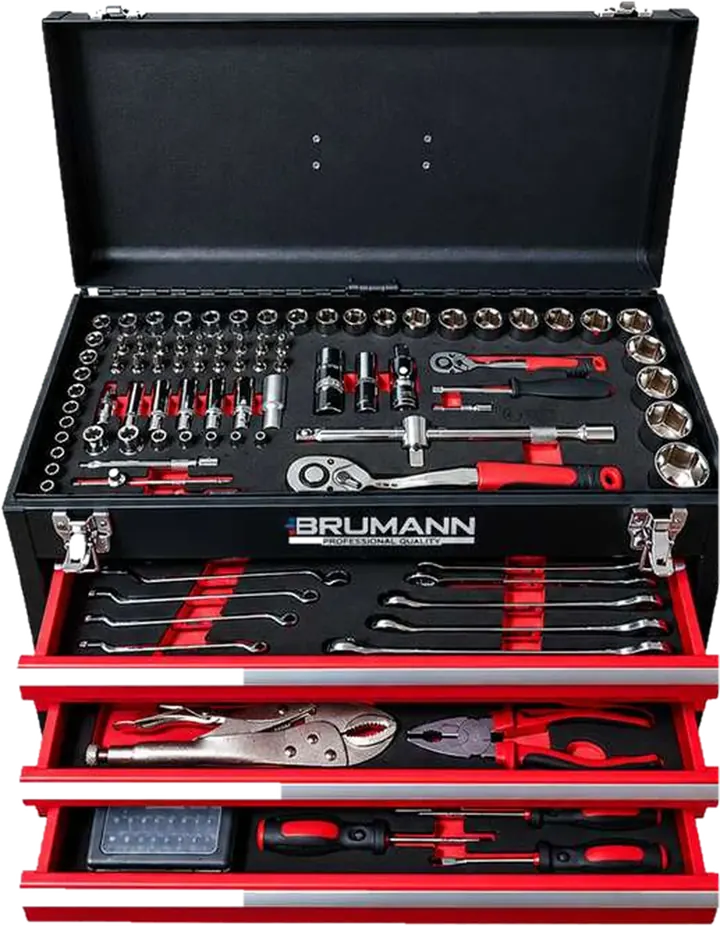
A complete kit that nobody carries helps no one. The service case is a light trolley on wheels weighing 13 kg (28 × 51 × 26 cm) that carries 110 tools and over 300 accessories, which makes trips across flat floors and car parks easier. The Minibox is a 22 kg metal chest (36 × 56 × 32 cm) with three drawers, 83 tools, central locking and self-locking drawers.
Case, Minibox or trolley?
- Service case (€199 incl. VAT): light, on wheels, for frequent travel.
- Minibox (€350 incl. VAT): metal chest with lockable drawers, for a vehicle or a small room.
- Max Edition (€899 incl. VAT): 261 tools and 8 drawers, for the workshop where you work every day.
Metric, inches: look at your machines
Depending on the machines you service, fasteners are metric, imperial, or a mix of both. Note the spanner and socket sizes that actually come up before putting the case together, and check that the set covers your sizes. A complete set that fits badly feels just like an incomplete one.
Three example set-ups
Mechanical breakdown work
Sockets and a ratchet in three drives, combination spanners, pliers, screwdrivers, a bit set, a mallet and fastening consumables. These are the tool families found in the Brumann case: sockets, pliers, screwdrivers, ratchets and a saw.
On-site and building work
More wall plugs, screws, cable ties and saw blades, plus a tape measure, a level and a knife. The case is useful above all for the consumables it holds.
Light aviation or motorsport
Here storage and traceability matter as much as contents. Each tool has an identified place, and the kit is checked before and after every outing. Torque tightening follows the machine’s documentation and is done with a torque wrench whose calibration is tracked.
Quality before quantity
A hundred and ten average tools are worth less than sixty good ones. For each family, favour tools that sit well in the hand, whose heads do not round off and whose markings stay legible. A tool that slips damages the fastener, and a damaged fastener turns a ten-minute fix into an hour of work.
Set-up mistakes to avoid
- Taking everything “just in case” until you can no longer lift the case.
- Forgetting the small socket and bit sizes, the ones used most often.
- Not allowing for light or for cleaning up.
- Mixing tools from another job into the same case.
Before heading out
- Count the tools against the reference photo.
- Check consumables: ties, screws, spare blades.
- Check the torch and gloves.
- Close and lock the case before loading it.
If you are unsure where to start, begin small: assemble the core families, work with the case for a month, then add. It is far easier to add the one tool you kept missing than to take out thirty you never touch.
The three complement each other: the trolley stays in the workshop, the case goes out on jobs, the Minibox lives in a vehicle or trailer. Do you resell or distribute these products? Trade prices are available on request.
The products we talk about.
More advice.
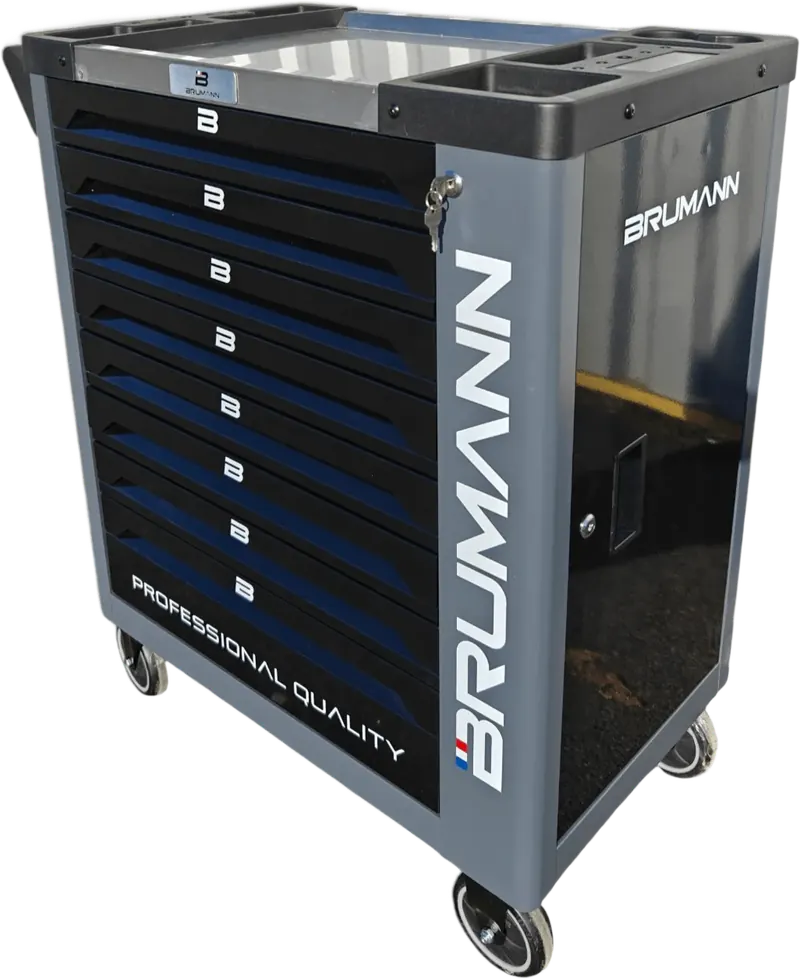
How to choose a workshop tool trolley
Use, drawers, locking, wheels, finish, budget: the criteria for choosing a workshop tool trolley, with a pre-purchase checklist.
Torque in aviation and motorsport: using a torque wrench properly
Tightening torque in aviation and motorsport: choosing a torque wrench, range, technique, tightening sequence, calibration and storage.
Are you a distributor?
Trade prices on request, products in your brand colours on request.